Sacred Order of Scientists
Last and First MenThe Sacred Order of Scientists was the institutional union of scientific prestige and religious authority in the First World State. Created as the supposed custodian of a supreme scientific secret, it was charged with serving both research and the worship of Gordelpus, the god of motion. Its authority rested on a contradiction: science had transformed material life, yet the promise that scientists possessed a world-saving power was sustained by secrecy, professional division, and religious belief rather than public proof.
Formation and Institutional Basis
The Order emerged from a scientific profession already organized as a privileged corporation. Admission to the International College of Science required an examination and substantial fees; membership conferred the title of Scientist, the right to conduct experiments, and eligibility for many lucrative posts. Members were also bound to preserve certain technical secrets. Rumors that a scientist who disclosed one had soon died mysteriously made professional secrecy seem more than a matter of convention.
Scientific specialization reinforced that isolation. Subatomic Physics alone contained a dozen fields, each said to be as complex as the whole of nineteenth-century physics. Researchers knew little of neighboring disciplines, hesitated to criticize work beyond their specialties, and guarded their departments’ territories. Technical philosophy had disappeared, while a popular pseudo-scientific framework assembled from journalistic fragments was disdained even by practitioners who unconsciously relied on it. In this climate, rumors that one branch possessed the secret of divine energy could persist: each department might suspect another of knowing it, while the profession as a whole avoided a clear denial.
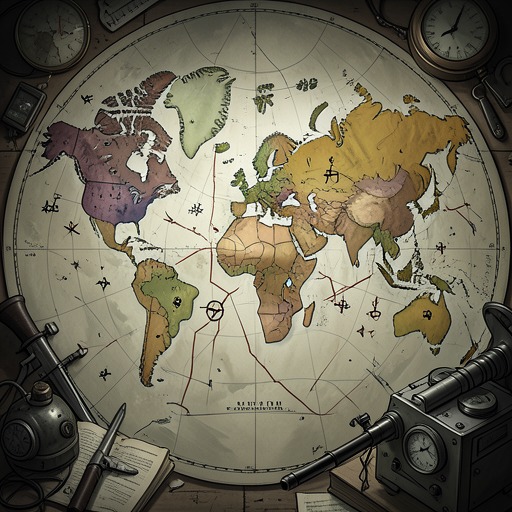
The political opening came roughly two centuries after the formation of the First World State, when its President declared that the time had come to unite science and religion. On an island in the Pacific Ocean that had become a center of cosmopolitan sentiment, leaders of Buddhism, Islam, Hinduism, the Regenerate Christian Brotherhood, and the Modern Catholic Church in South America declared their doctrines expressions of a shared worship of divine energy. They treated activity and stillness as compatible forms of that energy, and accepted the Discoverer as a prophet or incarnation of divine movement. The conference resolved religious differences through reconciliation rather than persecution, then turned to the institutional merger of faith and science.
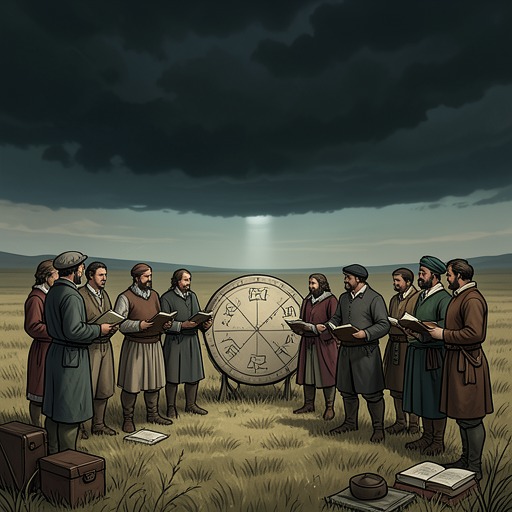
The International College of Science was asked to nominate a select body from its membership. The Church would sanctify the nominees as the Sacred Order of Scientists, maintain them at public expense, and free them to devote themselves to scientific service—especially research into the proper worship of Gordelpus. The proposal depended on the widespread assumption that scientists possessed a supreme secret, though they would not openly confirm it. Some scientists appeared uncomfortable; most concealed their satisfaction behind formal hesitation. The priests, too, had mixed reactions, but the Church stood to acquire science’s exceptional prestige. The Order was founded in this convergence of professional privilege, public subsidy, and religious legitimation.
Authority, Doctrine, and Practice
Science commanded unusual honor among the First Men not chiefly because of abstract understanding, but because applying scientific principles had changed their material circumstances. Inventive research still improved industrial technique even as pure intellectual curiosity waned and scientific doctrines hardened into dogma. The scientist was consequently seen not just as a knower, but as an embodiment of power. By joining this prestige to religious office, the Order gave institutional form to the belief that scientific knowledge could disclose or channel divine energy.
The Order’s responsibilities were framed as both scientific and devotional. Its members were to serve research and investigate the most scientific means of worshipping Gordelpus. Scientific work itself was absorbed into the religion of movement: elaborate mathematical descriptions of ritual, machinery, and natural phenomena were filed in the Order’s sacred archives, with the stated purpose of passing transient motion into the eternal being of the god. This arrangement made the institution more than a research body. It helped define which forms of knowledge were prestigious, what scientific labor was for, and how observation could be incorporated into religious practice.
Its authority also shaped the limits placed on technology. The Order prohibited the use of tidal energy because tidal motion was visibly astronomical in origin and had therefore acquired sacred status. That decision had practical consequences: tides remained an unused source of power even as the civilization’s energy supplies grew precarious. The prohibition illustrates how the merger of religion and science could sanctify natural processes while restricting their exploitation, despite the society’s heavy dependence on energy.
The Coal Crisis and the Defense of Ritual
For centuries, the First World State relied on coal, increasingly drawn from Antarctica after oil supplies were exhausted. Windmills, water turbines, volcanic energy, and heat from deep borings supplemented the fuel, but none displaced the rich Antarctic seams. When even the deepest borings failed to find further deposits, reports of the shortage initially met disbelief. The crisis raised the question of whether the society would abandon costly practices and reserve power for essential needs.
Ritual flying consumed more community resources than productive industry, so ending or sharply reducing it would have been a rational response. But flying was a sacred act and a source of status for its aristocracy. Its advocates instead demanded release of the secret of divine power and called on the Order to inaugurate a new era. Scientific authorities delayed, claiming that the moment of revelation had not arrived and that the coal failure was a divinely imposed test of faith. They urged the population to increase ritual flight, spend as little as possible on secular purposes, and trust that Gordelpus would permit the scientists to save humanity once devotion had been proved.
The policy converted a material emergency into a test of religious obedience. Luxury trades were abolished, workers were redirected toward agriculture, and mechanical power for tillage was to be eliminated as far as possible, while the energy-intensive flights continued. The reorganization exceeded the society’s remaining capacity to manage it. The Order’s prestige helped make such priorities credible, but the account does not establish that every act of the scientific establishment was directed by the Order itself.
Secrecy, Manufactured Signs, and Historical Significance
As hunger and disorder grew, scientists searched old scientific literature for the forgotten means of salvation and conducted clandestine experiments. They followed a false trail laid by an English contemporary of the Discoverer. Several researchers were poisoned or electrocuted, and a great college was destroyed in an explosion. The public interpreted these disasters as evidence that scientists had recklessly invoked divine power. That misunderstanding gave the desperate researchers an opportunity to stage further apparent miracles and restore confidence in the religious order.
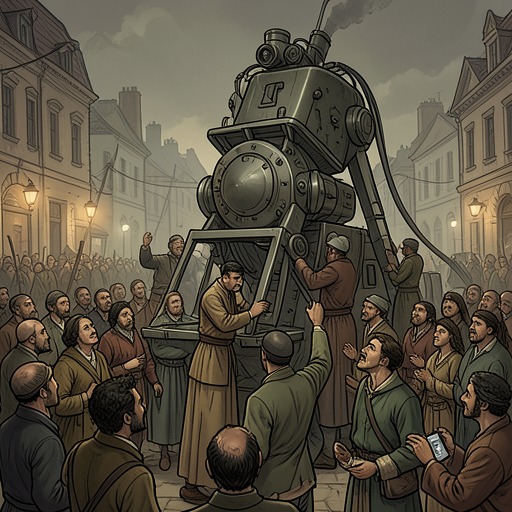
The staged interventions were used against people demanding necessities. When industrial workers petitioned for more flour, an explosion destroyed the ground beneath them and killed members of the deputation among the onlookers. When agricultural workers in China struck for a reasonable share of electric power for cultivation, a supposedly evil atmosphere caused thousands to choke and die. Presented as divine action, the violence restored the docility of a population whose faith had begun to falter, though hunger and ill health continued to increase. The episode shows how scientific prestige could shield the absence of a verified solution: calamity was recast as supernatural demonstration, and coercion as proof of divine authority.
The Order remained a dominant force in human affairs until the downfall of the First World State, but its claimed custody of saving knowledge did not prevent the civilization’s collapse. Its history links the prestige of science to the institutions that govern access to knowledge, the religious meanings attached to energy, and the political choices made under scarcity. The decisive irony is that a body established to unite science and religion became an authority through which technical uncertainty could be preserved as sacred secrecy, while a society facing an energy crisis was urged to spend its dwindling power on the very rituals that helped define its faith.